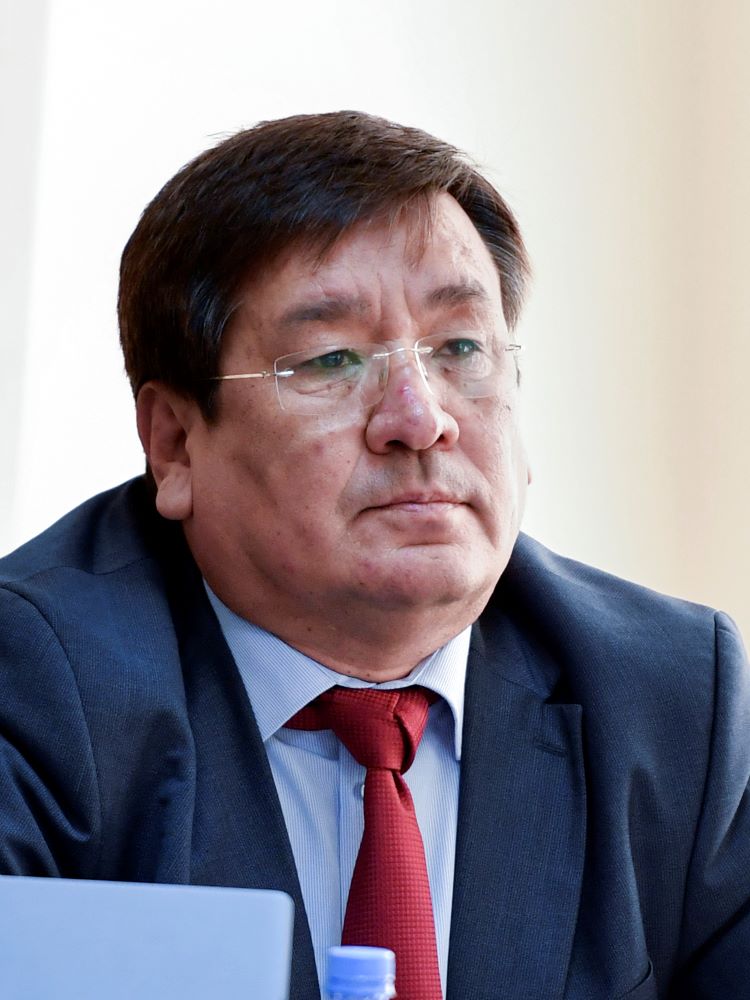



The participants of the "round table" organized by the Ministry of Culture and Information
and the Institute of Parliamentarism at the UDP of the Republic of Kazakhstan are convinced of this.
The history of mediation in Kazakhstan began in 2011, when the relevant law was adopted. And, according to experts, it has long been in need of revision. The concept of the development of the institute of extrajudicial mediation for 2025-2030 was discussed by the participants of the round table organized by the Institute of Parliamentarism under the UDP of the Republic of Kazakhstan and the Ministry of Culture and Information. It is expected that the use of mediation will reduce the level of conflict in society and relieve judicial authorities, while increasing the social responsibility of citizens.
Problems need to be solved
Aizada Kurmanova,
Vice Minister of Culture
and Information
The Ministry has a working group to develop proposals for improving state policy and state regulation of mediation activities. There are 16 organizations of mediators in the republic that have been registered in the form of self-regulatory organizations (SROs), in which more than 2 thousand professional mediators operate. A register of six retired judges has been formed, who carry out their activities on a professional basis. According to the akimats of cities and regions, about 1,770 public mediators also work.
We are working on approaches for the further development of the mediation institute. A number of problems require comprehensive solutions. The first concerns the registration of mediation organizations as SROs, which we have 16, while, according to the Ministry of Justice, 74 organizations in the country provide mediation services without registering as SROs, which creates legal risks. The issue of the mediator's responsibility for the provision of services that do not meet the requirements requires consideration. There are no clear legal norms for monitoring the activities of mediators and their organizations, which leads to a decrease in the quality of their services. Complaints are received from both citizens involved in the process and other mediators.
There are no legal mechanisms for monitoring and applying any sanctions for unscrupulous mediators. The only punishment provided for them is exclusion from the register of the organization of mediators. However, they can join the registry of another organization or open their own, which has a negative impact on the quality of mediation services and the image of mediation in general. Therefore, we support the proposal to create a mediation coordination council under the authorized body consisting of representatives of each organization of mediators included in the register.
Another problem concerns training, which is mandatory only for a mediator on a professional basis. No one checks the compliance of the courses with the Rules of the mediation training program. Each organization trains according to its own program, there is no single republican register of training trainers, as well as uniform requirements for them. Centralized accreditation of mediator training organizations and certification of mediators are needed, as well as delineation of the limits of professional and non-professional mediators.
It should become a familiar tool.
Leyla Zinasheva, Chairman of the Specialized
Inter-District Juvenile Court of
Astana
Prevention of family conflicts takes place at all stages of judicial proceedings, from the moment the claim is filed in court. Professional psychologists and mediators of the Reconciliation Center, who are stationed on the ground floor of our court, provide free services to the public in resolving disputes.
With the growth of the population in the capital, the number of incoming divorce cases is also increasing. In my opinion, such a mandatory pre-trial procedure as the conclusion of an agreement (notarial, mediation, participatory according to the will of the parties) the payment of alimony by one of the spouses, the child's place of residence, the order of communication, and the division of property at the legislative level could solve many family issues. At the stage of judicial proceedings, a significant number of lawsuits are terminated due to the peaceful settlement of disputes, whereas this issue could have been resolved out of court.
Thus, according to the results of the first nine months of this year, more than a hundred disputes have been resolved through mediation, and more than 1,800 cases involving the reconciliation of spouses in divorce lawsuits. Of course, there are many cases when one of the parties evades, does not want to conclude an agreement. Then the court will be provided with relevant letters about the failure of the mediation procedure, which will be the basis for consideration in court proceedings.
With the development of mediation procedures, questions arise about the quality and legality of the terms of the agreement, as there are claims for invalidation of agreements. With proper coordination of the authorized body and increased responsibility of mediators, such disputes in court could have been avoided. In my opinion, such a body should be a single republican organization of mediators (an association or chamber), whose competence would include such important issues as the development of common quality standards and an Ethical code of mediators, the creation of teaching aids to help mediators, and much more. Mediation as a pre-trial mechanism should take root in the minds of citizens as the most effective, less destructive way to resolve marital and family conflicts and become a familiar tool for our citizens.
This is not a way to avoid responsibility.
Balgul Raisova, lawyer
Bar associations of Astana
The concept of "mediation" is mentioned three times in the Criminal Code and 34 times in the Code of Criminal Procedure. In Kazakhstan, mediation is usually used in cases of compensation for material damage and is used to avoid criminal liability or mitigate it. While the main task of the mediation procedure is restorative and narrative in nature: when the party who committed an offense repents and apologizes, explaining the reasons for committing an action, which gives the injured party an understanding of the possibility of reconciliation.
Legislation needs to be improved so that the very nature of the mediation procedure in this area changes and becomes not a way to evade responsibility, but an opportunity to restore relations and help the perpetrator realize the consequences of his harmful actions. In the modern world, the composition of crimes and the methods of their commission are changing. There is an understanding that when material damage is caused, it must be compensated, but how to compensate for damage that causes more serious harm – virtual, reputational, moral and psychological?
For example, people who intentionally commit crimes using digital technologies clearly have the goal of seizing the property of others, so here we are talking about the value system of a person and society as a whole. Is it possible to terminate a criminal case only on the grounds of compensation for material damage? From a theoretical point of view, yes, from a moral and ethical point of view, no, because a person who commits such a deliberate crime will look for new ways and opportunities to enrich himself at the expense of others.
In some European countries, when conducting mediation procedures, the concepts of "public repentance" and "public apology" are used, which is possible only with a real awareness of what the offender has done. And this is the work of a mediator, which should lead to sincere repentance and the prevention of offenses. Therefore, mediation in criminal proceedings should be restorative in nature and be part of restorative justice, serving as a preventive mechanism for restorative justice.
In all cases involving the criminal prosecution of minors, a mandatory mediation procedure should be introduced, and it should be conducted by specially trained specialists. We should also consider the successful experience of China and the UAE, where this industry is developing successfully, using modern narrative technologies that we could also use.
Who is legitimate and who is not?
Zhandilda Zhakupov, President of NGO "International
Human Rights Center"
Firstly, I think it is necessary to transfer the institute of mediation to the jurisdiction of the Ministry of Justice, and not the ICI, as in our country. Lawyers, notaries, CSOs, and mediators are legal professionals and individuals in private practice.
Secondly, to date, just over ten mediation organizations have completed the process of becoming self-regulating. Are the other 60-70 organizations still operating? In addition, have all the requirements for self-regulation been met, and have audit and disciplinary commissions and other units been established? Courts and law enforcement agencies should accept mediation agreements only from mediators of organizations listed in the registry of the authorized body. All other agreements are illegitimate. But who's watching this?
It is necessary to strengthen the role of mediators at the pre-trial stage of dispute resolution, including through amendments and additions to the current legislation. For example, in Azerbaijan, a mandatory information conversation with a mediator on labor, family, and economic disputes has long been used as an effective tool for pre-trial dispute resolution. In Uzbekistan, investment disputes are necessarily considered with the participation of mediators.
We do not have a single Code of Ethics for mediators, as in Russia or Kyrgyzstan. Our organization has had a Code of Ethics since 2012, but it's a question of whether every mediator's organization has one. The current legislation does not clearly regulate the issues of mediation when one of the parties is a government agency. Another issue is the tax burden on professional mediators. We pay five types of taxes and payments, which range from 30 to 50% of the income. Contributions to the CSHI are also paid repeatedly from each type of income. Not all practicing mediators are registered with the tax authorities, there are overlays when submitting reports in the system and paying taxes when combining the activities of a mediator and sole proprietor. This needs to be edited, it's also a barrier.
Go beyond the usual norms of law
Kairat Tulekeev, Founder of NGO "International
Mediation Center"
The problem is that not everyone fully understands what mediation is. This is an element of the protection of the civil rights system, which includes courts and self-defense, and which operates according to a single principle of Romano-Germanic law. The population is increasing, and new types of disputes are emerging. Today, the judicial system has been overwhelmed by a wave of lawsuits, and the judge, who is required to comply with procedural deadlines, considers up to 200 cases per month. It turns out that he has to make decisions almost every half hour! What kind of quality can we talk about?
Mediation makes it possible to resolve this issue. 90% of all disputes and conflicts should be handled by society itself. There is a mediation right of citizens when they negotiate in simple human language, and the mediator competently forms out these agreements.
The mediator is an independent individual, he does not make any decisions. The main thing here is the commitment and responsibility of the parties. In case of non-fulfillment of the mediation agreement, they apply to the court for a court order, which is issued within three days. It's just that many people don't know about it, it's necessary to convey such information.
Mediation helps to go beyond the usual norms of law. The parties have the right to choose, and it clearly works in Kazakhstan, but not everyone uses it. One of the reasons is that the legal community is the first to oppose mediation, because lawyers make money from conflicts, and mediators make money from reconciliation. Therefore, mediation today is at a level of development where they are trying in every possible way to ride it and slow it down.
In addition, the mediator is treated as a procedural person, which is not the case, and mediators should not be given prospects to make decisions, these are direct corruption risks. The people themselves must come to an agreement, and the mediator must correctly draw up their agreements and monitor the responsibility of the parties.
Comprehensive measures to improve the sphere
Ruzanna Yessentemirova,
Executive Director of the NGO "International Bureau of mediation"
On behalf of the ICI, the Expert group prepared a draft Mediation Development Concept for 2025-2030, which describes comprehensive measures to improve the field of mediation in Kazakhstan, including improving the professionalism of mediators, the quality of services provided and expanding the possibilities of mediation. For mediation to develop, it must take root in the minds of citizens as the most effective and less destructive way of resolving conflicts in comparison with the courts, as well as become a familiar tool for resolving disputes and conflicts.
Creating favorable conditions for the development of mediation as a profession and improving the quality of mediation services involves changing the taxation regime for mediators, introducing uniform requirements for them, regardless of their main professional activity, and introducing specialization. For effective interaction with the authorized body and standardization of professional activities, it is planned to create a unified organization of mediators of national significance, as well as maintain a unified register of organizations of mediators, professional mediators and mediation trainers, consider citizens' complaints, attestation and certification. Among the tasks is the development of the law "On Public Conciliators" in order to separate the spheres of activity of public and professional mediators, as well as amendments and additions or the writing of a new Law "On Mediation".
Popularization of mediation as the most humane and comfortable tool for conflict resolution and ensuring accessibility of mediation for citizens involves the development of a single platform for turnkey digital mediation, the introduction of free guaranteed mediation assistance for needy segments of the population and non-judicial mediation in the public sector, the introduction of mandatory information conversation with a mediator on all categories of cases in courts, police, criminal- the executive system. It is proposed to open conflict resolution centers in courts, mediation services in educational, medical organizations, akimats, and mediator's offices that provide services directly to the public.
Mediation is also expected to be developed in all areas of public relations: marriage and family, commercial, criminal, education, and the public sector. The expected results of the implementation of the concept are an increase in awareness of mediation in society, an increase in trust and interest in the mediation procedure, an increase in the number of appeals to mediators and a decrease in the number of appeals to the courts, as well as a reduction in the number of complaints about the actions of mediators.
https://kazpravda.kz/n/sfera-mediatsii-nuzhdaetsya-v-glubokom-reformirovanii/